The winners of the 14th Architizer A+Awards are live! Discover a global cohort of architects shaping the future of design, and subscribe to our Awards Newsletter for future program updates.
The landscape was always an afterthought. Until recently, form and function took central stage, positioning the architect as the “mastermind” of a project – the most important piece of the puzzle – while roles such as interior or landscape architects were mostly seen as supporting players. However, current architectural problems are no longer primarily projects of form. They are problems of systems and relationships.
Once upon a time, buildings were doing the heavy lifting, situated on sites that had a relatively stable landscape. Now, climate change has introduced a different type of challenge, requiring architects to design the relationships between water, heat, habitat, materials, building forms and so forth. Suddenly, landscape starts doing the heavy lifting, because it is no longer viewed as an aesthetic addition but as infrastructure. For example, a wetland can provide flood protection while also restoring a habitat; or a park can hold stormwater as well as reduce urban heat and create additional civic space.
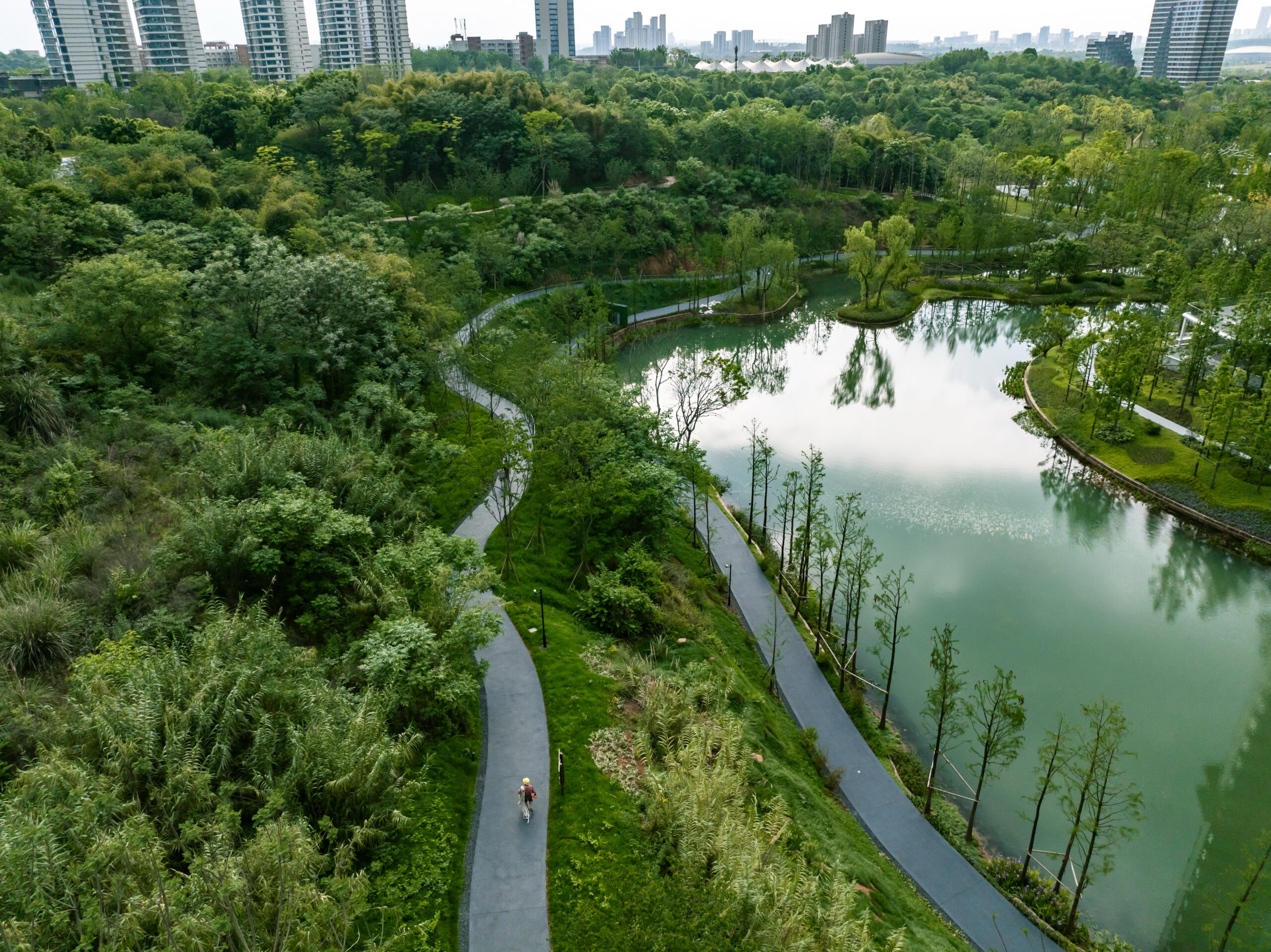

Green Field Park by Sichuan Ledao Landscape Design Co., Ltd, Chengdu, China, Jury Winner, Landscape & Planning – Public parks & Green Spaces, 14th Architzer Awards
Green Field Park is a mountain landscape in Chengdu, deliberately preserved during the city’s urban expansion. Located on the western side of Longquan Mountain, the park covers approximately 17.3 acres, offering citizens a recreational space, and retaining in parallel a real and continuous urban habitat for wildlife. The project focuses on ecological systems instead of architectural objects, where the landscape performs essential hydrological work by restoring micro-wetlands that drain or replenish rainwater. Strangely, the project’s most pivotal architectural strategy is restraint: paths follow existing ridgelines, rest areas occupy natural clearings, and the overall construction happens within the smallest footprint possible, without disturbing the flora and fauna within the site.
Yet how does this new “landscape infrastructure” differ from traditional systems? Consider a traditional water filtration installation – a wall holds water back, pipes remove it and mechanical systems ensure that the conditions remain the same throughout the year. On the other hand, landscape architects take advantage of the variability present on site. They work with succession, seasonality, adaptation and overlapping ecological processes. They construct “operating systems” that pair water filtration with people and flower species with energy.


Ecoparque: Ciénaga De Mallorquín by DEB ARCHITECTURE, EL EQUIPO MAZZANTI, Barranquilla, Colombia, Landscape & Planning – Urban & Masterplans, 14th Architzer Awards
One strong example is the Ecoparque: Ciénaga De Mallorquín, which replaces a fixed barrier with a living boundary. Its network of paths limits urban expansion into the mangroves and manages the movement between Barranquilla and the wetland. Specifically, it gives the previously altered and polluted wetland the time and space to regenerate rather than “forcing” recovery through mechanical systems. The “landscape” then consists of multiple layers including ecological flows, more than 200 bird species, artisanal fishing, public circulation and civic activities – and infrastructure becomes the mediator between their relationship.
Finally, this new type of infrastructure also has a public face. In other words, landscape architecture is not reduced to environmental engineering. Unlike much conventional infrastructure, landscapes can perform technically but also remain accessible, pleasurable and culturally relevant. They inhabit dual identities: a park can manage water and still be a place for play. In that sense, ecological performance and human experience need not be separate agendas and in contrast this multifunctionality needs to be celebrated because, frankly, it reveals landscape architecture’s greatest asset: its ability to solve several problems with the same spatial system.


Downtown Cary Park by OJB Landscape Architecture, Machado Silvetti, Cary, North Carolina
Downtown Cary Park in Cary, North Carolina functions as both civic infrastructure and a public destination. The seven-acre landscape anchors a rapidly growing community while providing accessible space for recreation. Its most “loud” multifunctional piece may be an oversized rainwater scupper, situated in the Bark Bar Pavilion, whose technical function also becomes a visual centerpiece. In parallel, the whole complex also mediates between the town’s built fabric and its open public realm, shifting from the more historic downtown edge to a more naturalistic environment. Lastly, the site becomes home to five pavilions that expand the landscape’s social capacity, turning it into flexible social infrastructure rather than a passive green space.
Ultimately, there is a change in hierarchy. The discipline that was once treated as the final layer now provides the first set of instructions. The reason? The world itself has changed the order of operations: instead of designing an object and then addressing its surroundings, teams are increasingly asked to begin with watersheds, ecosystems, climate patterns and community needs, where architecture becomes one component within a larger, living framework. Unfortunately, we are crossing an age defined by environmental uncertainty. Fortunately, landscape architects have long understood what the rest of the profession is now discovering: the future of design depends less on isolated objects than on the relationships that allow them – and the communities around them – to endure.
The winners of the 14th Architizer A+Awards are live! Discover a global cohort of architects shaping the future of design, and subscribe to our Awards Newsletter for future program updates.
Featured Image: Ecoparque: Ciénaga De Mallorquín by DEB ARCHITECTURE, EL EQUIPO MAZZANTI, Barranquilla, Colombia, Landscape & Planning – Urban & Masterplans, 14th Architzer Awards
The post Beyond the Object: How Landscape Architecture Became the Framework for Contemporary Practice appeared first on Journal.