Ami Nigam, Global Head of Design AI & Technology at Benoy, is a speaker at RELEASE [AEC] — the first tech event designed to help professionals stay on the cutting edge of innovation and master the tools of the future. The next edition will be held in Paris on October 20, 2026. The event is 100% free for AEC practitioners: register today!
We’re at a crossroads with recent advances in Artificial Intelligence (AI). As an industry, we’re looking at profound transformations in what we do, how we do it and how we compete. But we’re not just competing with other professionals who’ve gone through the same rigorous training as us; we’re competing with models that have read every building code and every award-winning portfolio ever published without ever attending a client meeting.
A Large Language Model (LLM) doesn’t know what’s at stake in a design review or planning committee. It hasn’t gone through the laborious process of working with thousands of other professionals to deliver a building that someone will one day walk through, celebrate in, live their life in. It might look like it knows the full picture to the untrained eye, but it doesn’t know what a space feels like, why negotiating certain aspects of a space is important, or how we might use judgment to deliver a better outcome for the built environment and the people who experience it.
Despite these limitations, this technology is undeniably seductive. When used right, it can help you articulate a design idea through a visual, a video or a 3D world (sometimes faster than you can finish thinking), research a specific aspect of a project, write code to generate geometry or run specialist sustainability simulations and help you make crucial decisions.
What This Means In-House
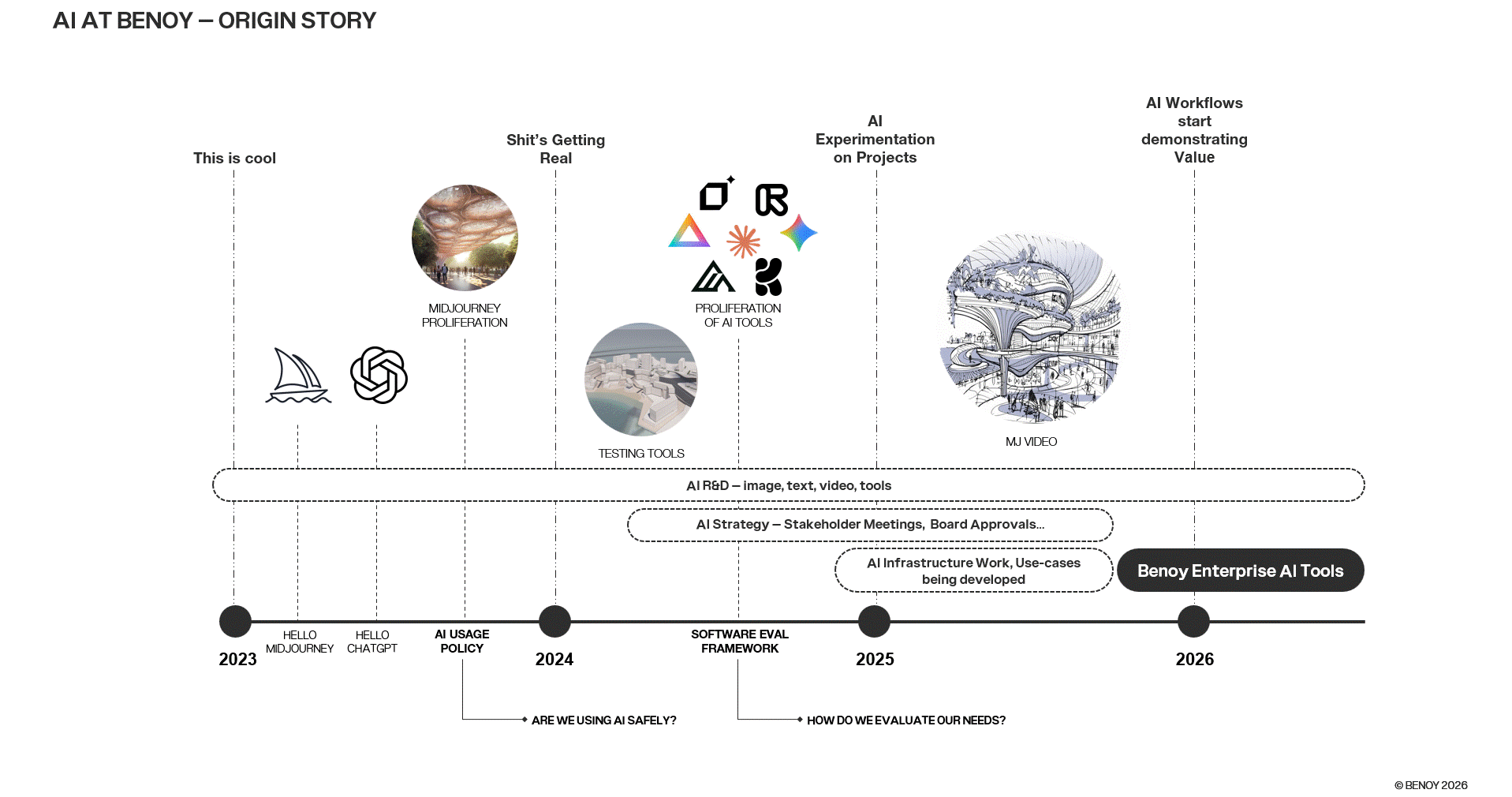
Towards the end of 2022 and early 2023, like a lot of people in the profession, Benoy was experimenting with tools like Midjourney and ChatGPT in protected sandboxes, away from live projects. As a business, we felt what this technology could do to our work. But we were also cautious.
When we rendered an image with D5 or Enscape from a Rhino or Revit model, we knew that this image was created using our own GPUs, the output file stayed on our servers, and we controlled the journey that this file took and how that worked with our confidential projects. For a mid-to-large design firm operating across the world for almost 80 years, trust from our clients is critical. We work on projects with strict confidentiality agreements and care deeply about intellectual property – both ours and our clients’.
This was around the same time that the industry started looking at SLAs and Terms of Service Agreements. High-profile industry peers, including May Winfield from Buro Happold and Shane Burger from Woods Bagot (now SOM), started highlighting the risks associated with these contracts.
As a business that was both excited about this technology yet deeply distrustful of ambiguous contracts, we arrived at these conclusions:
1. Enterprise AI will be as good as the data it can access and the tools it’s integrated with.
2. Some of the data it needs to operate on is highly sensitive.
3. We can’t wait for vendors and software companies to build it for us. We’ve got to do it ourselves.
A Word of Caution for Automation
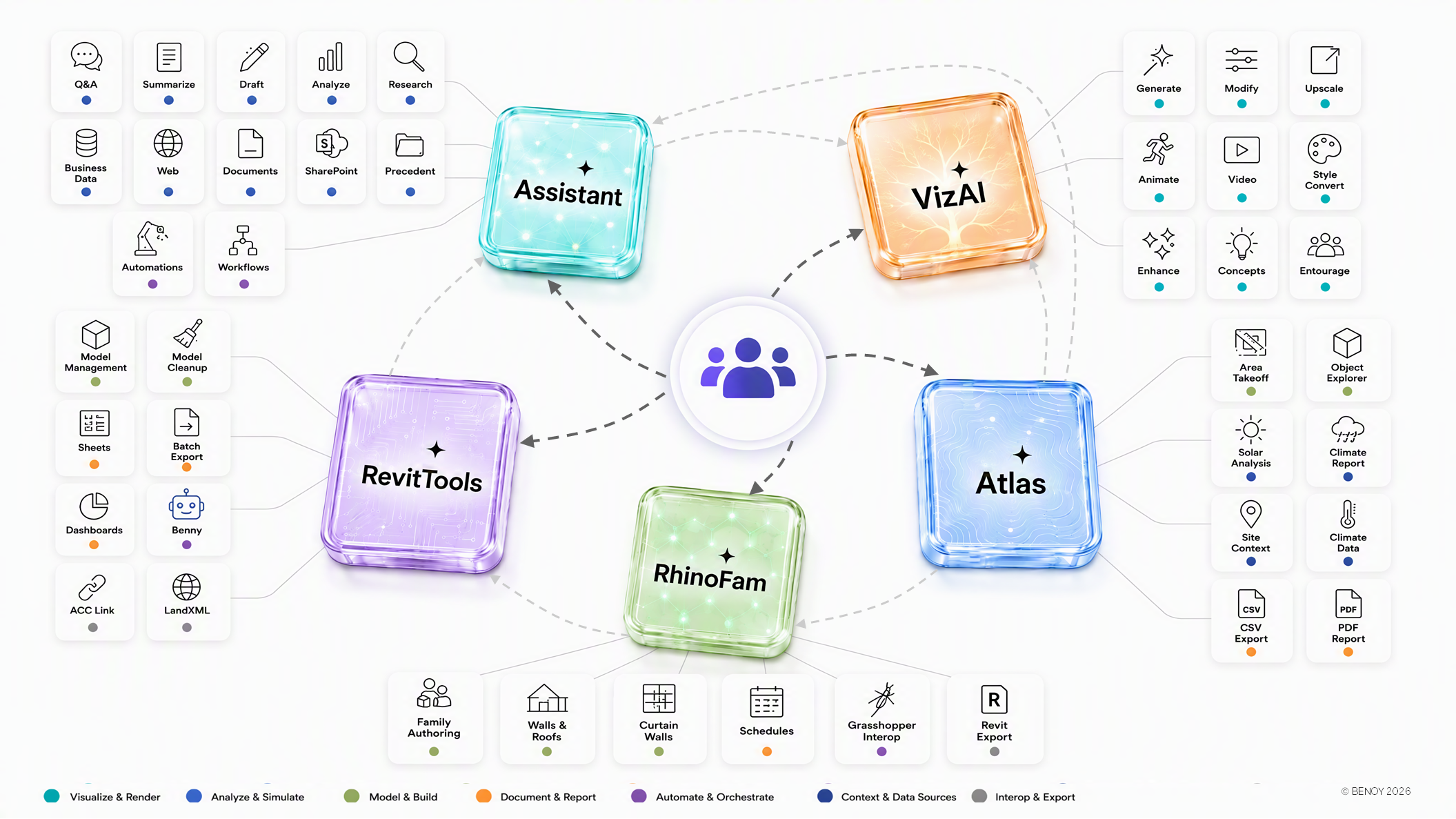 We now sit on sophisticated AI infrastructure. We have a data lakehouse that stores our business data, which is supported by an ecosystem of AI tools that are integrated with design technology. This allows our design teams to remain at the center of this ecosystem.
To reach this point, we had to ask ourselves: what do we want to automate, what do we want the AI to do, and what’s got to remain undeniably and unequivocally human?
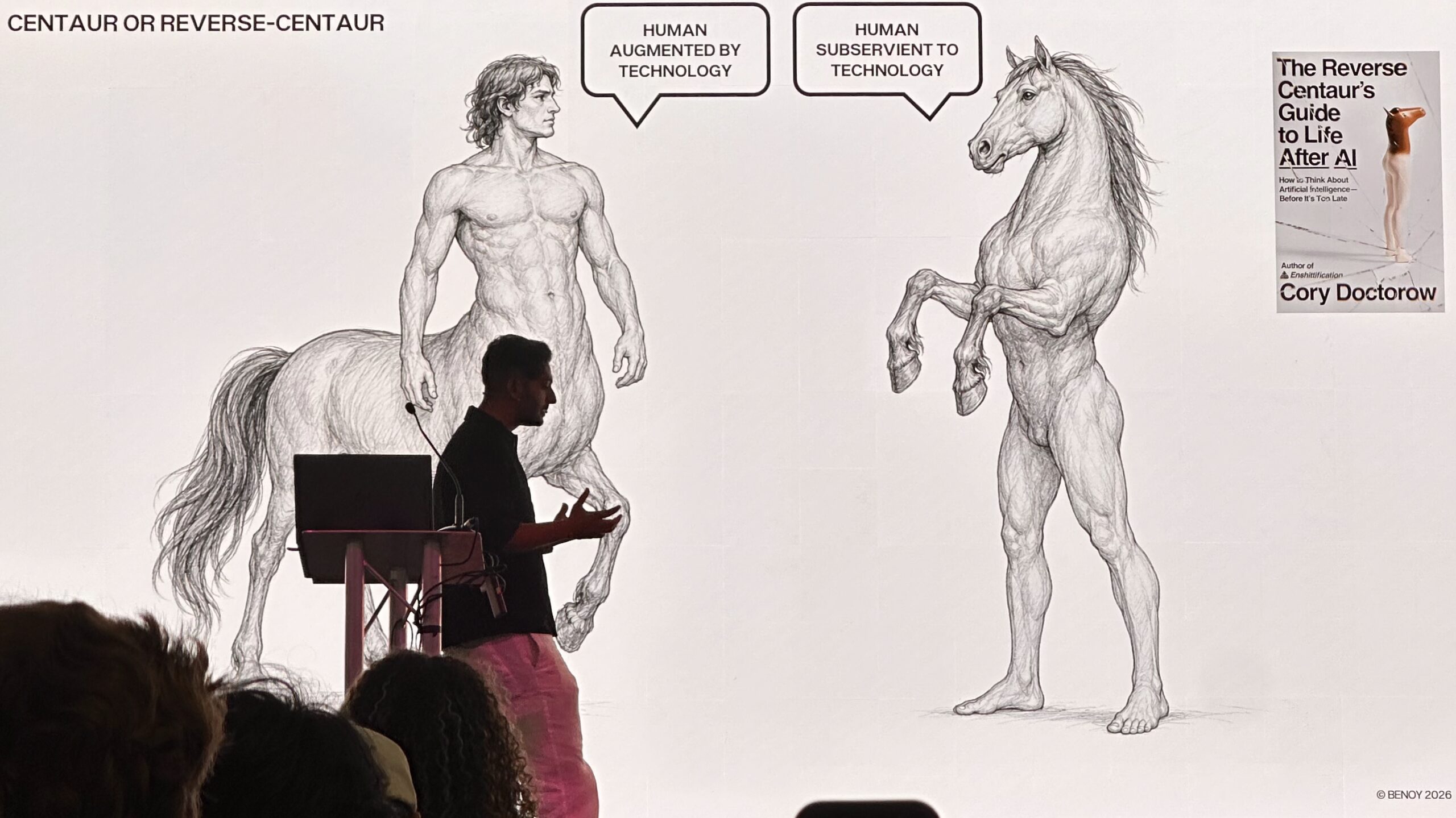 This brings me to a very important concept I often think about as we build our AI ecosystem: A centaur (human judgment, horse-like speed), versus a reverse-centaur (horse judgment, human-like speed).
In automation theory, this is an analogy that describes the relationship between humans and technology. In my world, a centaur is a human designer using AI to assist with dimensioning drawings or adding metadata to BIM models, while a reverse-centaur is an AI designing while humans struggle to keep up with validating its outputs.
As we build tools, we need to think about whether we’re building for the centaur model or the reverse centaur. While our tools are designed to be powerful, they need to function as subordinate co-pilots to our designers.
Creating Solutions to Real Problems
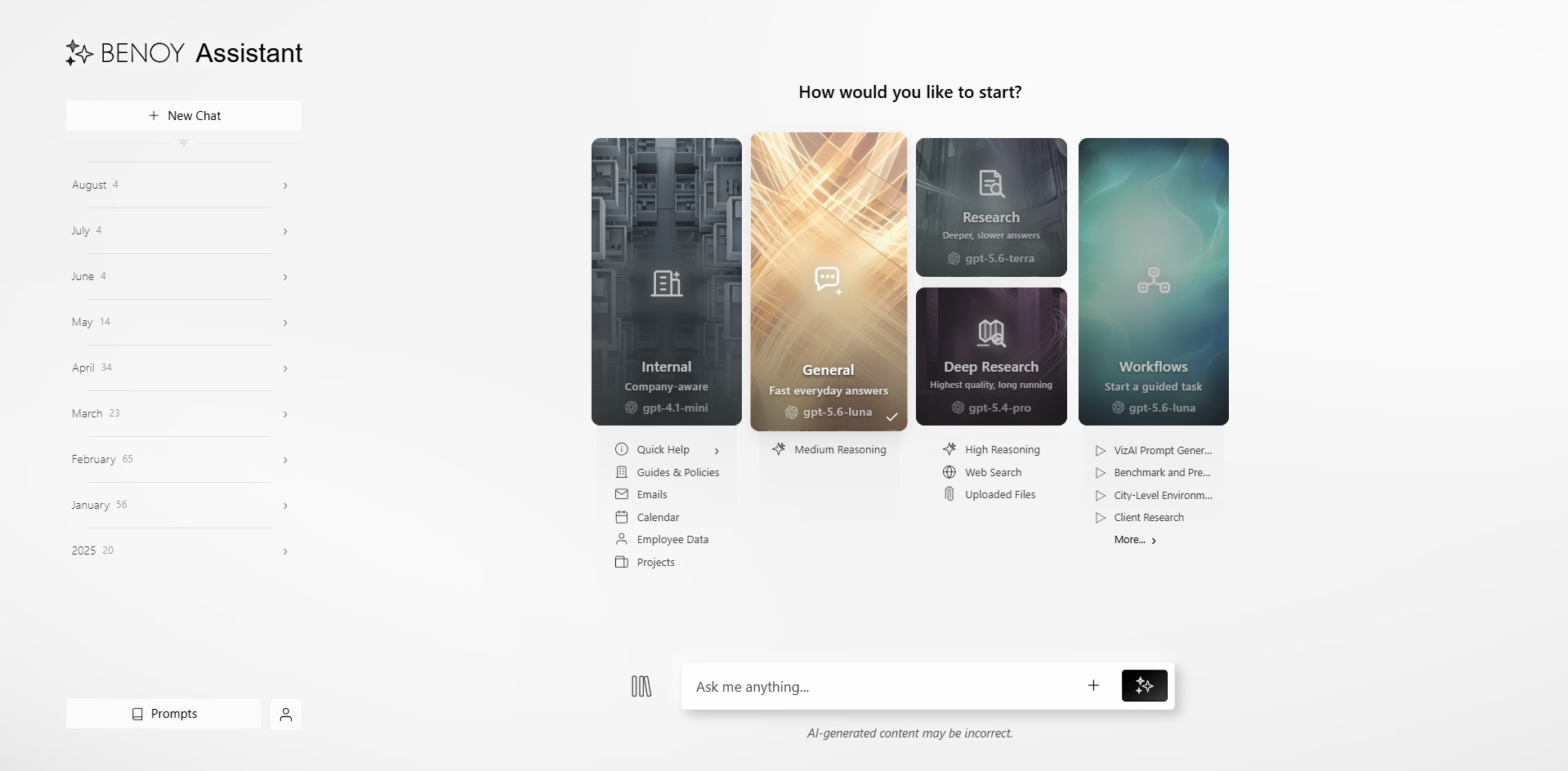 Our in-house Benoy Assistant breaks through the siloes of business data to answer powerful questions and surface information quickly. Team members ask it everything from how much annual leave they have left, to how to name a Revit model, to what we learned on a historical project. Separately, and just as importantly, it’s wired directly into our business intelligence workflows. It also manifests inside Rhino and Revit, helping automate processes or run computational design scripts.
Benoy VizAI allows our teams to articulate ideas faster than ever before. It’s built with encryption by default, bringing state-of-the-art visualization models to our design teams from Google, OpenAI, Black Forest Labs and other providers, and we fine-tune prompts and add prompt injections based on usage and contextual data, such as project information and SharePoint data, even client emails. A gallery showcases the best work from across our global studios, complete with prompts, configurations, and settings, as a key distribution mechanism so everyone in the company can effectively recreate something they like.
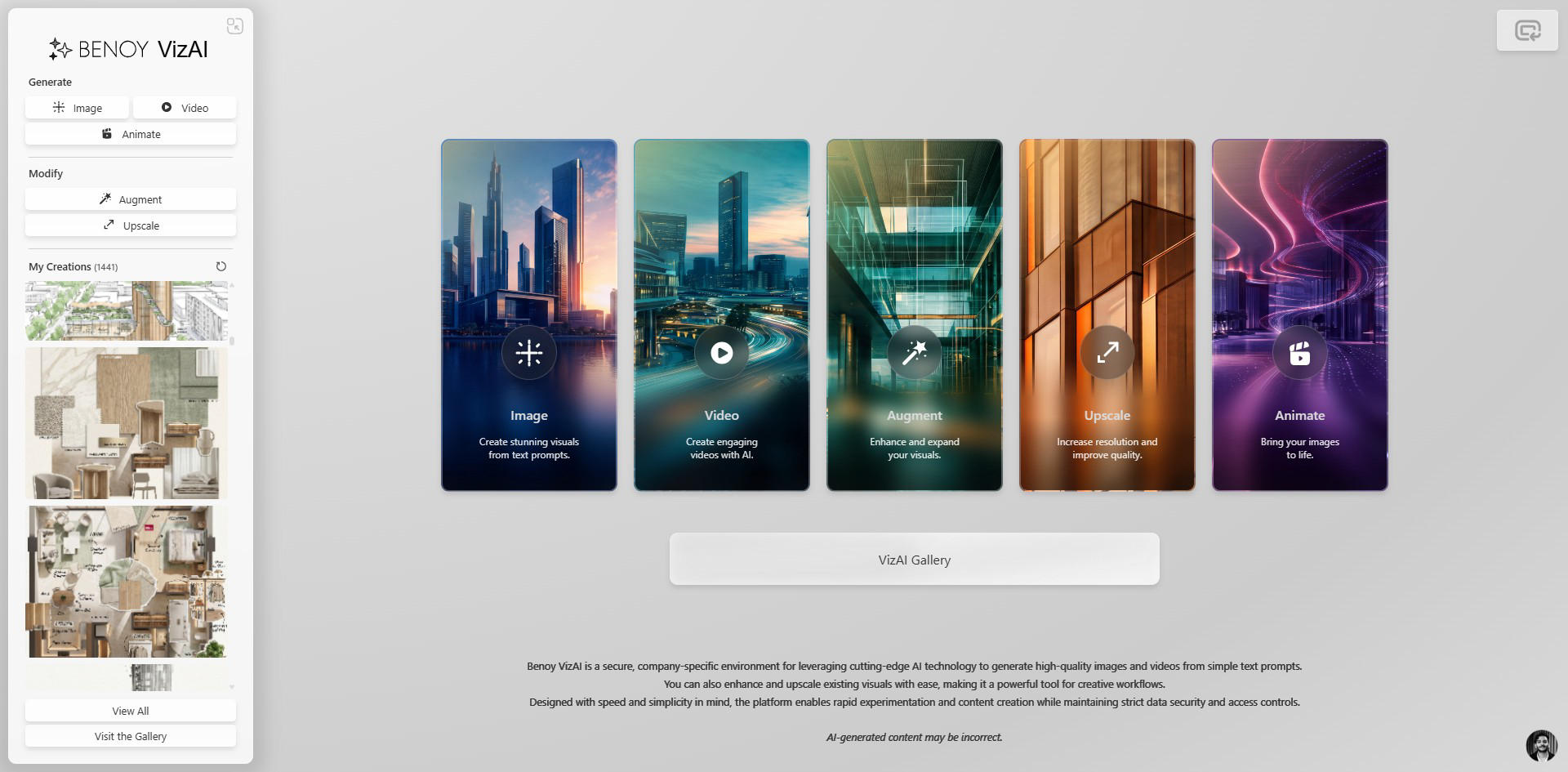 Our in-house tools like Atlas, RhinoFam and Revit Tools all reduce execution friction for things like setting up and printing hundreds of sheets, adding data to BIM models and running sustainability and computational design workflows at scale — things we would typically expect from a BIM or design technology specialist scaled across the practice.
The key here is that these tools are specifically built for how we work. Each tool communicates with the others, shifting our digital tools from a set of disparate parts to an ecosystem of connected workflows, allowing our teams to stay in the driver’s seat. These workflows are now deeply embedded in our design teams, with tools like VizAI performing over 100,000 runs since its launch just over six months ago. You’ll find it open on desktops in every studio, from graduate level through to directors.
 This integration has been possible because we have practitioners in the cockpit, working hand in hand with our IT team, people who understand the value and challenges of the profession and the infrastructure it runs on, who’ve been burned trying to add data to 50 BIM models, or set up 10,000 sheets, or run sustainability simulations.
I believe this profession should be the one shaping its own evolution, not whoever sells the best demo. Losing control of what we build might very well lead to the reverse centaur scenario where the technology is in the driver’s seat while we become validators of mediocre design.
As someone who is building Design Technology and AI capability on a large scale, I’m confident that if we make the right decisions at this crossroads, we can create better outcomes for the profession. We can build a world where execution friction is reduced, where you spend your energy on the idea instead of wrestling the tool into doing what you meant, and where an outstanding built environment is crafted for future generations — the centaur scenario.
Ami Nigam, Global Head of Design AI & Technology at Benoy, is a speaker at RELEASE [AEC] — the first tech event designed to help professionals stay on the cutting edge of innovation and master the tools of the future. The next edition will be held in Paris on October 20, 2026. The event is 100% free for AEC practitioners: register today!
The post Team Centaur: How Benoy Built Its Own AI Ecosystem appeared first on Journal.